
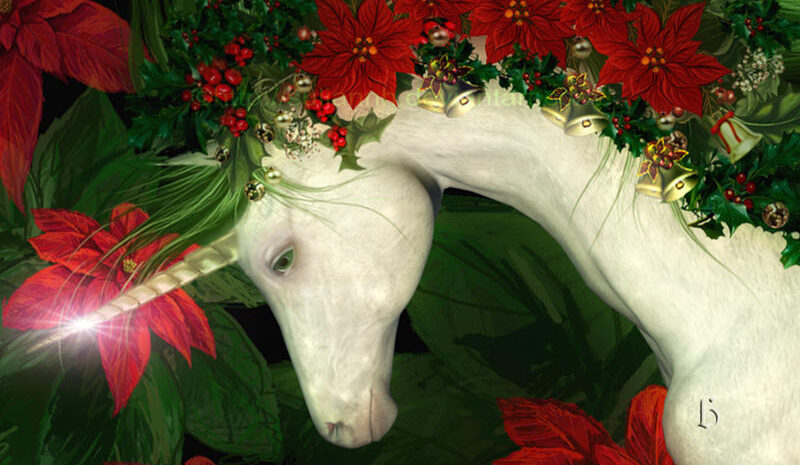
Most of us are familiar with the shepherds and wisemen of the Christmas story. Few are unaware of the angels and the star, King Herod and Mary and Joseph. But have you heard about the unicorns? They are there, but perhaps you overlooked them. If so, l would like to point them out to you.
But first, allow me to set the stage.
There is a growing pessimism about the future here in America. From a loss of institutional trust, the threat of international terrorism, continued unrest in the Middle East, and climate change to increasing political polarization and tribalism, rising inflation and mounting national debt, and a loss of shared imagery of common good—fueled and exaggerated by mainstream and social media—have made our current era into the New Age of Anxiety.
What are some tragic consequences of living in such an age? Addiction—both process (e.g., gambling, gaming, internet use, etc.) and substance (prescription and illicit drugs, alcohol)—is on the rise. Mental health diagnoses have taken an unprecedented leap. Deaths of despair have dramatically increased. Anxiety is killing us.
Against this backdrop, while times have changed, the emotional milieu of Palestine two thousand ago was not altogether much different from today’s. Israel and the entire Mediterranean basin had been conquered by the Roman Empire. The Jewish people were captives in their own land. Heavy taxes burdened local economies. Many families were displaced. Roman law suppressed important aspects of age-long customs and culture.
On top of that were four hundred years of silence. Four centuries of God’s seeming absence between Malachi and Matthew. A long history of rebellion, exile, pillage and devastation of country made it difficult to have any confidence that Israel’s best days were yet to come. The book of Proverbs reminds us, “Hope deferred makes the heart sick” (13:12). Continued delay and postponement of God’s saving intervention take an emotional toll on any people. When hopes are repeatedly unrealized, disappointment sets in and despair soon follows.
Notwithstanding.
Two lone people stood out amidst these anxious times. Two unusually hope-filled people. “Unicorns.” They are found in Luke’s account of the Christmas story.
Luke writes that Simeon was “a man in Jerusalem who was righteous and devout.” That is the extent of our knowledge about him. His claim to fame was that he was “waiting for the consolation of Israel” (2:25). He was looking for the encouragement (literally, paraclete, “to call to one’s side”) of his people. Then one day, moved by the Spirit, he goes into the temple courts, sees the baby Jesus and takes him into his arms, and praises God for sending Israel’s long-awaited hope.
Anna, the other unicorn, was a prophetess from one of the lost tribes of Israel, Asher. She was exceptionally old at eighty-four (average life expectancy during that time was 30-35 years) and had been a widow most of her life. All this while, she served in the temple, worshipping day and night, fasting and praying, “looking forward to the redemption of Jerusalem” (Lk. 2:38). Waiting for Israel’s promised deliverance. Upon witnessing Jesus being dedicated by his parents at the temple, she like Simeon recognizes that he is the fulfillment of God’s promised future for his people and renders thanks to God.
Two people who, despite unfortunate personal and social conditions, did not fold in trying times. Two people who exhibited a resilient hope in God and his word that invigorated and animated their lives. Hope is not immunity against trouble and affliction, but it is power to push through as we witness of Simeon and Anna. Without hope—the “profound certainty” (literal meaning of hope) of God intervening—we die. Maybe not literally, but in every other way . . . mentally, emotionally, relationally.
The good news is that God came down. He arrived two thousand years ago in his Son Jesus Christ to usher in the new age of God’s glorious rule with this announcement: “Repent, for the kingdom of heaven is at hand” (Matthew 4:17). Christ subsequently went around demonstrating and giving evidence of this long-awaited kingdom through his life, teachings, and miracles, culminating in his resurrection from the dead. We call this Advent.
Christmas is a time when we celebrate his first coming: “Joy to the world, the Lord has come!” Christmas is also a time when we look forward in hope to Christ’s second coming when he will complete what he began, reconciling all things to himself (Colossians 1:19-20). When swords will be beaten into plowshares and spears into pruning hooks and nations will no longer train for war (Isaiah 2:4). When the wolf will live with the lamb and the calf and with the lion and a little child will lead them (Is. 11:6). When the whole earth will be full of the knowledge of the Lord as the waters cover the sea (Is. 11:9). When the Lord Almighty will prepare a feast of rich food for all peoples and wipe away the tears from all faces and remove the disgrace of his people from all the earth (Is. 25:6, 8). When everything will be put to rights and all will be made well!
So, as we live between the “now and the not yet”—between the inauguration and consummation of God’s kingdom, the inbreakings of Christ’s appearances—joy should abound in our hearts. The future has already begun! If Simeon and Anna could wait patiently and expectantly, excitedly anticipating God’s actions in spite of their dire circumstances, we have no excuse on this side of Christ’s first coming. What is more, Christ’s resurrection is guarantee that he is able and determined to undo the worst that Sin has brought—Death itself. Tis is all the more reason we should look forward to the future! Unicorns should now be the norm, not a rarity, not the exception.
Friends, Christmas hope is powerful. It funds perseverance and resistance. It enlivens and emboldens. It is dangerous. It propels us to take loving risks and, if necessary, die for the sake of others. Christmas hope is the stabilizing force of our lives, preventing drift from all the heavy winds, waves, and currents that come against us. As the writer of Hebrews ardently reminds his congregation, “We have this hope as an anchor for the soul, firm and secure” (6:19).
History does not end with a big fireball, in one gargantuan cloud of smoke. No, the story closes with God coming down to dwell with humans, redeeming every vexing chapter of each of our mini stories and making all things new (Revelation 21:3-5)! Think about it: Every square foot of contested ground will be fully and finally brought under his righteous, wise, and peaceful rule! In light of this, John the Revelator closes his book (written to believers suffering for Christ) with this beautiful promise and prayer: “He who testifies to these things says, ‘Yes, I am coming soon.’”
“Amen. Come, Lord Jesus.”
“O come, O King of nations,
bind in one the hearts of all mankind.
Bid all our sad divisions cease
And be yourself our King of Peace.
Rejoice! Rejoice!
Emmanuel shall come to thee, O Israel.”

Dear Jeff,
Thank you for lifting me up in my spirit and reminding me to keep my mind and heart on God’s promises and the wonderful things He has accomplished for us. And to be full of that unshakeable hope and joy in our Lord for all around us to see!
Hi Karen, Thanks for your kind words. I hope Tim and you are doing well. God’s grace to you and yours!
Didn’t catch the comparison of Simeon and Anna to Unicorns, what connection were you trying to make?
Hey Steve, thanks for the question. I can appreciate the missed connection. I mean “unicorn” in the secondary way . . . “something that is highly desirable but difficult to find.” Simeon and Anna were “odd” next to their peers in the sense, they had a special “power,” . . . they believed, they hoped–in spite of all that challenged such bold faith.
Great word. I love the analogy Brother.
Thanks Dave! Blessings to you and yours! Merry Christmas and Happy Unicorns!