
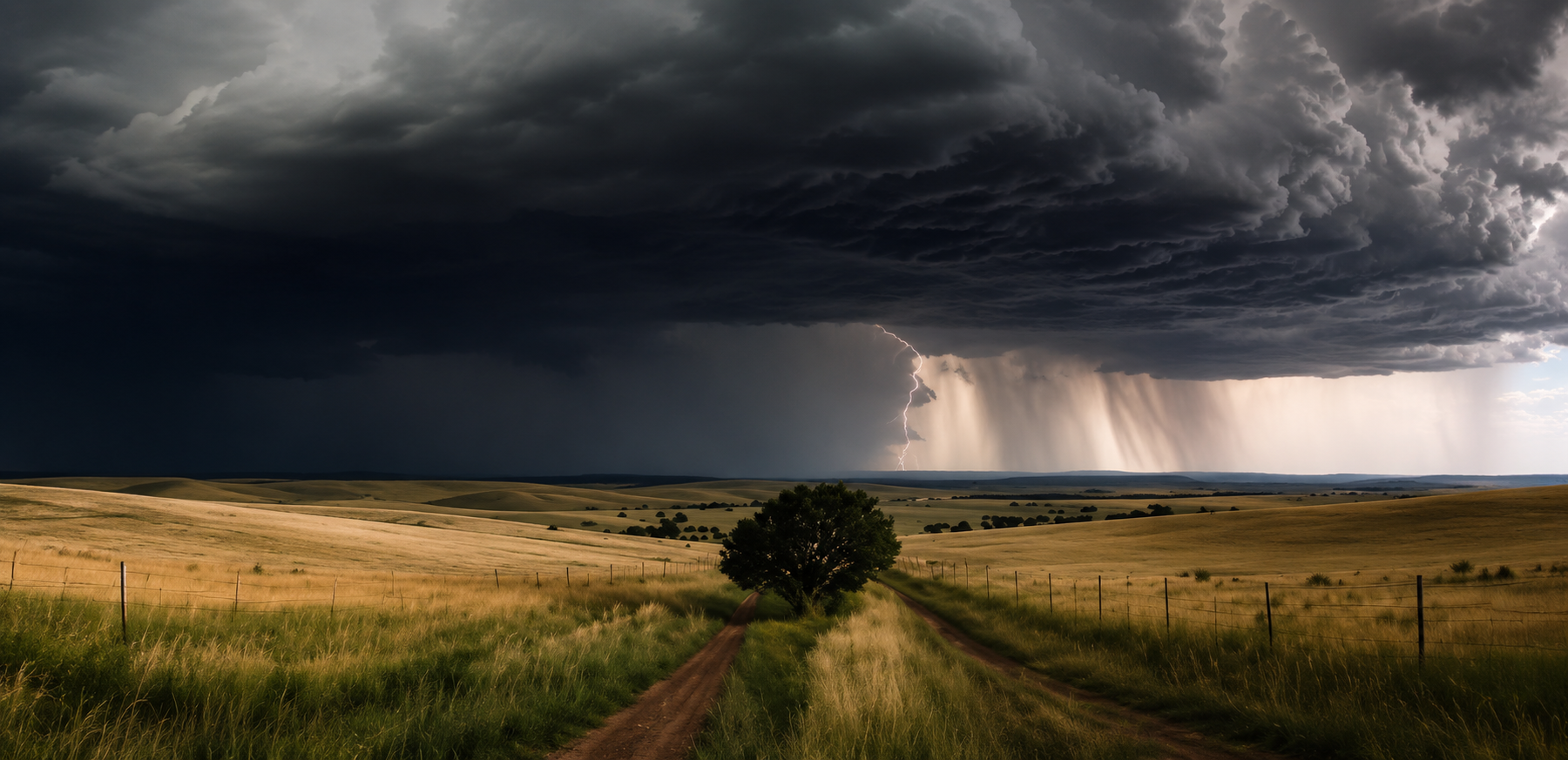
“I want to help prepare you for the thunderstorms that are coming. Troubles are ahead. Some you will see coming. Many more will totally blindside you.”
This was how I opened a recent graduation service for four men who were completing our year-long residential program.
I am weary of all the pep rally speeches, “Your best days are ahead! You’ve got what it takes! Dream big and go hard! Believe you can, and you can.” The spiritualized versions of these “pump up” messages are not much improvement: “You’re the head, not the tail. You’re a child of the king. No weapon formed against you will prosper. You can speak to mountains, and they will move!”
I am not a doomsayer. Nor am I a “glass-half-empty” kind of guy. It is just that the hype and hoopla mantras are so plastic and unrealistic and set people up for terrible disappointment.
Life is hard. Things seldom go as planned—relationships, careers, family vacations, . . . putting together a stupid IKEA storage cabinet. Bodies break down. Houses fall apart. Kids don’t listen. The neighbor’s dog is afflicted with a barking demon. Every road you drive is under construction! Your email gets hacked. You forget your password and get locked out of an important user account. You get ghosted, cancelled, and unfriended. You lose your keys (me!), wallet (me!), pens (me!), the remote (me!), and socks (we have a sock-gobbler in our laundry room that I can’t catch). God was not kidding when he said, “The ground you tread will bear thorns and thistles, and by the sweat of your brow you will eat your food.”
The Apostle Paul wrote, “The creation was subjected to frustration” (lit., frailty, imperfection, failing of results designed results; Romans 8:20). There is a futility factor that cuts through the entire creation. Everything has been infected and corrupted.
At Life Challenge Ministries, we want to help people learn how to cope with hardship and heartache. Pain is one of the major reasons people abuse alcohol and drugs. If a man or women does not learn how to deal constructively with the suffering—from the normal vicissitudes of life (e.g., traffic congestion, clogged toilets, a child breaking an arm, identity theft, etc.) to the big whammies (death, natural disaster, car wrecks, divorce, etc.)—the odds of returning to the “vomit” are high.
So, how do we gear up? How do we prepare for the storms ahead?
I don’t pretend to have all the answers. There are many things that can and need to be said on this subject. But at the risk of sounding too simplistic or overly theoretical, I want to highlight one truth packed in a set of words that can make an incredible difference in your and my life.
Next to Jesus, if there was ever a man who knew loss, difficulty, stress, and alienation—it was Job. Blow after blow comes his way. His business goes bankrupt. All ten of his children are wiped out in one fell swoop. To top things off, he becomes agonizingly ill. His wife finally counsels him to end it all, “Curse God and die.”
Yet how does he respond? What does he say? With his life spinning out of control, how does he specifically frame his unimaginable tragedy? Answer: “The Lord gives and the Lord takes; may the name of the Lord be praised” (Job 1:21).
Notice: He did not say, “God allowed me to have a successful company and raise a boatload of kids, and then he permitted all these treasures in my life to go up in smoke.” No. That would have been too soft, too lame. He said, “God did it. He gave, and he took.” There is a difference between being allowed and being ordained. And then comes this commentary twice: “In all this, Job did not sin by charging God with wrongdoing” (Job 1:22; 2:10).
What can we learn? God is in charge. He calls the shots. He makes the decisions. God is not partially sovereign or mostly sovereign. He is completely sovereign. This is perplexing. Upsetting. Humbling.
And it is comforting. God is not just finding ways to mop up the messes we make that somehow managed to slip past Him. He is ahead of them, before them, in them, and working through them for our good and his glory.
This does not make God indifferent or unmoved by human suffering and pain. He cried over the death of his friend Lazarus (see John 11). He was moved with compassion over a leper (see Mark 1). He got angry when a bunch of religious big shots were shaming a woman who had been targeted in an adulterous act (see John 8). He is a God who wore flesh, entered our pain and took on our sorrows. He is not some steel, impassive deity unaffected by our pain. The writer of Hebrews affirmed that we have a high priest who can truly sympathize with our weaknesses (4:15).
By God being sovereign, I am not implying that we are in a closed and fated system, passive agents without voice or recourse, doomed to bide our time. God’s sovereignty does not obliterate human agency or eliminate human autonomy and freedom. How it all works together, I have no idea.
Job’s simple but profound confession was that God is in control. God is intimately involved, interfacing and intermingling on every level. God is the master meddler, the ultimate micro manager. So, we need not fear! One pastor puts it like this, “The sovereignty of God is the most encouraging and comforting doctrine in all of Scripture. An understanding of it removes the anxiety from life.”
I am not making light of calamity. Nor am I suggesting that we have some cavalier, “buck-up/cheer-up” attitude when trouble finds us. We are not to dance around coffins or applaud when a house fire kills a family in our community. No, we weep and mourn. We lament. We protest. Job did. He tore his robe and shaved his head and fell to the ground. However, we do not do these things as those without hope.
God is in charge. Nothing gets past him. The psalmist wrote, “The Lord does whatever pleases him, in the heavens and on the earth, in the seas and all their depths” (135:5-6). In his own inscrutable, incomprehensible way, he is working out all things for good.
What is the proper response to this truth? Worship. Job said, “May the name of the Lord be praised!” The worth of God shines most magnificently when—in the aftermath of the calamities with which we are stricken—instead of cursing God, we exclaim, “The Lord gives and the Lord takes, may the name of the Lord be praised.”
Friends, God reigns. Regardless of how things are going in your world, you can be confident that a good and wise and sovereign God is overseeing all of your affairs, every last detail of them. So, resolve to rejoice. This does not mean we cannot cry or shout out our complaints. But in the very midst of our agony, may we humbly submit to his rule and render to him the honor both he deserves and which we owe him.
We have to rehearse this faith declaration over and over until it becomes second nature. We have to get it into our spirit. And we must do this before the bad times come. If we wait until calamity strikes, it will be too late. In the storms, our emotions tend to get the best of us.
“Who shall separate us from the love of Christ?
Shall trouble or hardship or persecution or famine or nakedness or danger or sword?
As it is written: ‘For your sake we face death all day long;
we are considered as sheep to be slaughtered.’
No, in all these things we are more than conquerors through him who loved us.”
(Romans 8:35-37)

Thanks Jeff for the encouragement and reminder to rehearse this faith declaration over and over until it becomes second nature: “The Lord gives and the Lord takes, may the name of the Lord be praised!” Will writing it 100 times on the chalkboard be helpful for storage in the memory bank . . .
Appreciate the post.
Denise, thanks for your kind words. And YES!!! Writing on a chalkboard 100 xs just might be the trick!!!
Amen 7 TIMES!!!!!!! We are unbreakable 💪🙏
Chris, You are an inspiration! Love ya!
Great title: “WHEN calamity Comes”
I heard it recommended for new believers: Read Genesis to learn about the world, read John to learn about the Lord Jesus Christ, and read Job to learn about life. I love God’s sarcastic question to Job after he complained, “And, Job, remind Me, where were YOU when I made the World?” {Paraphrased}
God’s sovereignty does not exclude our responsibilities, of course. “God provides food for the birds but He doesn’t throw it into their nests”.
Thanks for the helpful article, Pastor Jeff.
In Christ, John Simpson
That is some good “fodder” for the soul! Love ya John!
Well said brother. Thank you.
Thanks Rusty! Hope you are well and enjoying good health. Blessings!
Jesus is king my friend 🧡
Excellent message God reins
Thanks Lois. It’s been a while since I last connected with you. Hope you and yours are doing well. God bless!