
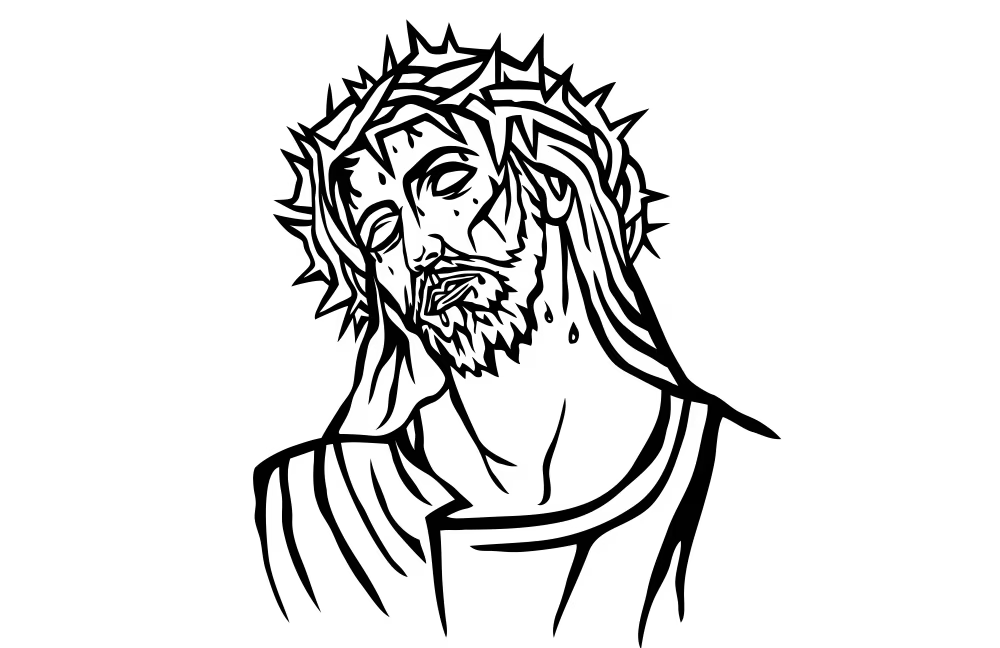
I was blindsided. Jesus appeared to me.
As I scurried through the building to my office at our center, I had to go through a larger room adjacent to the lobby which was occupied by two people. I proceeded quickly and quietly so as not to be disruptive. However, I could not help looking to my right where I stole a quick glance at Dr. Sheila Burrell, our Women’s Supervisor, who was interviewing a young lady in her mid-twenties for the program. Upon seeing the sight that greeted me, I rushed to my bathroom where I closed the door and sobbed like a baby.
“Jenna’s” appearance clearly indicated that she was a victim of abuse. The tilt of her head, the look in her eyes, the slump in her shoulders, and the sad face I will never forget expressed unimaginable hurt and suffering. On the other side of the table sat Sheila. A warm peacefulness radiated from her as she looked tenderly at Jenna and communicated these words without ever opening her mouth, “I see you. I hear you. I feel your pain.”
Rejection met welcome. Violence was greeted by grace. Brokenness and lovingkindness kissed. Jesus was revealed. I was overwhelmed by beauty and born again.
It was the Russian writer Fyodor Dostoevsky who coined the phrase, “Beauty will save the world.” Beauty is powerful. It captivates and awakens the soul. It stirs the heart and lifts the spirit. It causes us to stop and linger. It frees us from self-obsession and inwardness. It brings a profound sense of peace, joy, and well-being. It funds perseverance and delivers from apathy. Beauty, along with truth and goodness, is among the three transcendentals—all of which are foundational, universal, indisputable essentials for human flourishing. We can live without them no more than we can live without water.
Life without beauty is boring and unsustainable. Have you ever asked yourself how much addiction is the result of an absence of beauty? To what extent is reckless and wild living driven by the deep-seated but irresistible yearning for wonder, thrill, and enchantment–that which is beautiful? We can bear only so much dreariness until we are driven to seek some form of escape.
Beauty comes in many shapes and forms—a painting, a landscape, an exquisitely prepared dish, a song played, a dance, a home or building, even a mathematical formula (for all you geeks out there!). We may differ as to what we deem beautiful. I have car buff friends who drool over big engines and sleek body frames. Get me in a bookstore, and I become intoxicated by the sights and smells. (I recently visited the Library of Congress in Washington D.C. and thought I had gone to heaven!)
There is one beauty, however, that we can all agree upon . . . the beauty of love. Whether a mother’s love for her newborn infant, a little daughter’s love for her daddy, a grandparent’s hard-won love for a grandchild (someone once told me, “If I had known ahead of time how much joy there was in grandchildren, I would have skipped the children!”), the enduring love of an elderly couple, a teacher’s devoted and tireless love for her students or a coach’s for his players, the loving bond between two friends . . . even the love of a man or woman for their dog or cat. Love is the pinnacle of beauty. No one can deny that.
Mystery of all mysteries, the greatest and most tantalizing beauty emerges in the most unexpected place. On the site of a garbage dump, otherwise known as “Place of the Skull.” The sadistic, insidious, and maniacal powers of hell are met in the degrading, cruel and agonizing bloody death of Jesus Christ crucified. In that awe-full showdown at Calvary, the infinitely costly, unconditional love of God absorbs the just wrath of God and decisively defeats Sin, Satan, and Death. Beauty beyond comprehension! Beauty that will never cease to allure and amaze. Beauty that will forever be rhapsodized by the angelic hosts, “Worthy is the Lamb, who was slain” (Revelation 5:12). Reflecting on the action of God in Christ at the cross, the Apostle Paul declares, “God demonstrates his own love for us in this: While we were still sinners, Christ died for us” (Romans 5:8). Notice the tense of the verb “demonstrates.” What happened two millennia ago continues to be an on-going, present revelation of love . . . beauty.
Christ’s cross inaugurates a whole new world organized around forgiveness, humility, generosity, forbearance, welcome, kindness . . . radical, co-suffering love. At the cross, the principalities and powers are put to shame, exposed for what they are, . . . ugly, profane, and dehumanizing. Violence, jealousy, greed, pride, sexual exploitation, the lust for power, religious bigotry, nationalism, etc. are disarmed and seen for the monstrous, diabolical evil they are.
As followers of Christ, we are called to join with Jesus and take up our own cross. To perform the gospel. To exhibit in our everyday, ordinary lives the way of Christ through the painful beauty of peace-making. Only as we model Christ crucified will people come to believe. Christian apologetics is not ultimately about winning minds with arguments. It is about capturing hearts through aesthetics—living beautiful lives.
The gospel of Jesus Christ does not need to be explained so much as enfleshed. The grotesque beauty of Christ crucified storied by his followers is enough to change any life. It did the Roman soldier in charge of Jesus’ execution as witnessed by his exclamation, “Truly this was the Son of God!” (Mark 15:39) If such a demonstration can transform the most hardened of individuals, surely as Christians “re-enact” the terrible yet wonder-filled death of our Lord, many more blind eyes will be opened to the spectacular beauty and saving glory of Jesus Christ.
The cross is the defining feature of the Christian faith. It is the ground of our hope. The cross is testimony that nothing is too bad that God cannot make beautiful. Brian Zahnd puts it exquisitely, “Every cross adorning a church is in itself a sermon—a sermon proclaiming that if Christ can transform the Roman instrument of execution into a thing of beauty, there is hope that in Christ all things can be made beautiful.” If God can make the absolute worst Friday—Good Friday—no amount of evil can sabotage God’s unwavering determination to “Easter” his broken world and make everything beautiful in its time (Ecclesiastes 3:10).
In the wake of this pristine beauty, Paul’s confession is an invitation to all: “I have been crucified with Christ and I no longer live, but Christ lives in me. The life I live in the body, I live by faith in the Son of God, who loved me and gave himself for me” (Galatians 2:20).
**************
The Wonderful Cross (Chris Tomlin)
See from his head, his hands, his feet
Sorrow and love flow mingled down
Did ever such love and sorrow meet
Or thorns compose so rich a crown
Chorus
O the wonderful cross, O the wonderful cross
Bids me come and die and find that I may truly live
O the wonderful cross, O the wonderful cross
All who gather here by grace draw near and bless
Your name
